
What should I do if someone needs immediate help for alcohol addiction?
If someone needs immediate help for alcohol addiction - whether because they are in medical danger from withdrawal, in a psychiatric or emotional crisis, or at a moment of acute readiness to seek treatment - how you respond in that window of time matters enormously. This page provides clear, specific guidance for each of the scenarios that might constitute an immediate need for help, so that you are prepared to act quickly and effectively when the moment demands it.
Scenario 1: Medical Emergency - Severe Withdrawal or Overdose
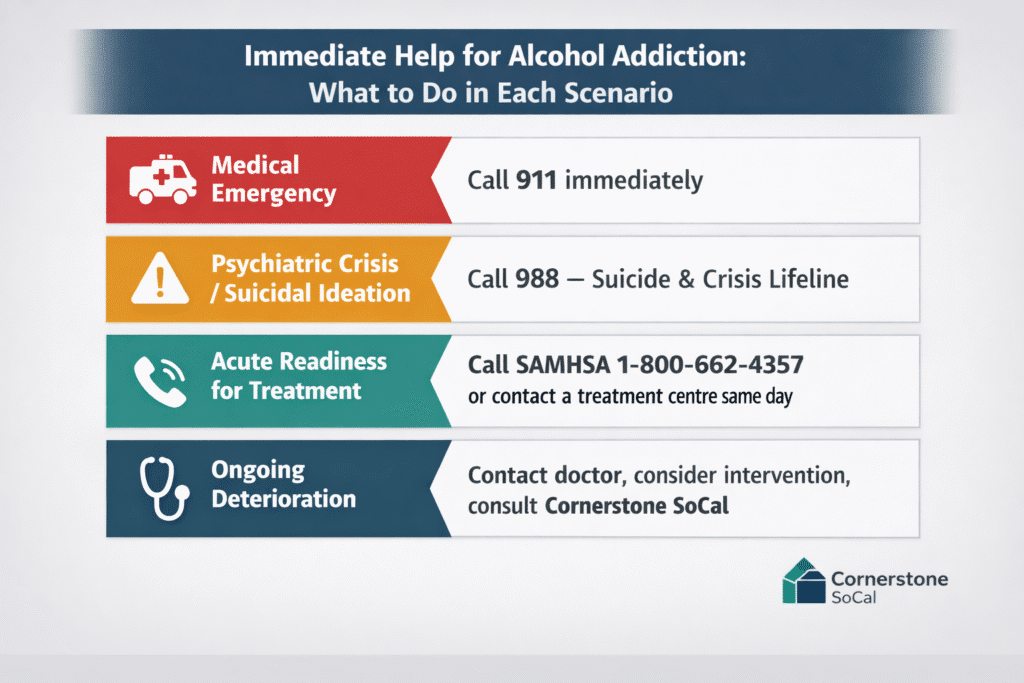
If someone who has been drinking heavily is showing signs of severe alcohol withdrawal or alcohol-related medical emergency, call emergency services (911) immediately. Do not wait. Signs that require immediate emergency medical response include:
- Signs of delirium tremens (DTs): Severe confusion and disorientation, high fever, profuse sweating, extreme agitation or trembling, hallucinations (seeing or hearing things that are not there), rapid heart rate. DTs can develop 48 to 96 hours after the last drink in someone with severe dependence - it is a life-threatening medical emergency.
- Seizures: Any seizure occurring in the context of recent alcohol cessation or reduction is a medical emergency. Keep the person safe from injury, do not put anything in their mouth, and call 911 immediately.
- Loss of consciousness or unresponsiveness: Someone who cannot be woken or is unresponsive requires immediate emergency medical attention.
- Signs of acute alcohol poisoning: Confusion, vomiting, seizures, slow or irregular breathing, blue-tinged skin, hypothermia. Place the person on their side to prevent aspiration and call 911.
- Chest pain, difficulty breathing, or signs of stroke: Any cardiovascular or neurological emergency requires immediate 911 response regardless of its apparent connection to alcohol.
While waiting for emergency services, stay with the person, monitor their breathing, keep them as calm as possible, and be prepared to provide the emergency responders with information about what substances have been consumed and how recently.
Scenario 2: Psychiatric Crisis - Suicidal Ideation or Self-Harm
Alcohol use disorder significantly elevates the risk of suicidal thinking and self-harm. If someone is expressing suicidal thoughts, threatening to harm themselves, or has already hurt themselves:
- Call 988 (the Suicide and Crisis Lifeline) immediately - this line is available 24/7 and can provide immediate crisis support, guide you through what to do, and connect to local emergency services if the situation warrants it.
- If there is immediate danger to life, call 911. A mental health crisis involving imminent risk of death is a medical emergency that requires emergency services.
- Stay with the person, listen without judgment, and do not leave them alone if they are in immediate danger.
- Remove access to means - if it is safe to do so, remove or secure access to alcohol, medications, or any other potential means of self-harm.
Scenario 3: Acute Readiness - Someone Is Ready to Get Help Right Now
Moments of genuine, acute readiness to seek help for alcohol addiction are precious - and they are often brief. The window between "I want to get help" and "I've changed my mind" or "I'll do it tomorrow" can close quickly. If someone expresses genuine, immediate readiness to seek help, act on it the same day if at all possible:
- Call SAMHSA's National Helpline immediately: 1-800-662-4357. The helpline is available 24/7 and can provide same-day referrals to local treatment facilities, detox centres, and crisis services.
- Contact a treatment centre directly: Most residential treatment centres - including Cornerstone SoCal - have intake lines available beyond standard business hours and can conduct a preliminary assessment and begin the admission process by phone. Having the contact information of treatment options you have identified in advance means that when readiness arises, you can act immediately rather than searching.
- Go to the nearest emergency department if detox is needed urgently: Emergency departments can initiate alcohol detox assessment, manage acute withdrawal safely, and connect people with appropriate ongoing treatment. This is a particularly important resource when someone needs help immediately and outside of standard clinic hours.
- Do not postpone: The most common outcome of "I'll sort it out tomorrow" is that the acute readiness passes and weeks or months go by before the conversation is had again. If the window is open, use it.
Scenario 4: Ongoing Deterioration - When Waiting Has Become Dangerous
Sometimes the immediate need is not a single acute crisis but a pattern of deterioration that has reached a point where waiting longer is itself dangerous - escalating health consequences, increasing instability, mounting psychiatric risk. In this scenario:
- Contact the person's primary care doctor if they have one - a physician can conduct an urgent assessment, manage immediate medical risks, and initiate referrals to appropriate treatment.
- Consider a professionally facilitated intervention - a structured process, guided by a trained interventionist, that brings family and close friends together to communicate concern and present a clear, immediate pathway to treatment. This is not appropriate for every situation, but for some families it is the most effective way to create a decisive moment of action.
- Contact Cornerstone SoCal for a family consultation - we can help families assess the situation, understand the options available, and develop a plan for what to do next, whether or not the person with addiction is ready to engage directly.
Be Prepared Before a Crisis Happens
The best time to prepare for a crisis is before one occurs. Having the following information accessible before it is urgently needed makes a significant practical difference:
- SAMHSA Helpline: 1-800-662-4357
- 988 Suicide and Crisis Lifeline: Call or text 988
- The contact information for local detox facilities or treatment centres
- Your loved one's primary care doctor's emergency contact information
- The nearest hospital emergency department
At Cornerstone SoCal, our intake line is available to families and individuals navigating urgent situations. We can help you understand what is needed, what is available, and how to take the next step - whatever that step needs to be. In a moment of crisis or readiness, please reach out. We are here.
In Network With


















What Clients Say About Cornerstone

We are here for you

Danielle Graniello is a healthcare professional from Orange County, California, with more than 14 years of experience supporting patients and families across medical, treatment, and mental health settings. She spent nine years working with individuals affected by traumatic brain injuries and spinal cord injuries, developing a strong foundation in compassionate care, patient support, and complex healthcare needs.