
What is the difference between alcohol abuse and alcohol addiction?
The terms "alcohol abuse" and "alcohol addiction" are often used interchangeably in everyday conversation, but they carry distinct clinical meanings that matter significantly for understanding the severity of a problem and determining the appropriate response. Whether you are trying to understand your own drinking, support a family member, or navigate treatment options, grasping the difference between these concepts - and how they are currently framed in clinical practice - is genuinely helpful.
How Were These Terms Used Historically?
For several decades, the psychiatric diagnostic system distinguished formally between "alcohol abuse" and "alcohol dependence" as two separate diagnostic categories. Under DSM-IV (published in 1994), alcohol abuse referred to a pattern of drinking that caused repeated, significant harm in areas like work, relationships, health, or legal standing - but without the hallmarks of physical dependence (tolerance and withdrawal). Alcohol dependence, by contrast, was characterised by physical adaptation to alcohol, including tolerance and withdrawal symptoms, alongside compulsive use and loss of control. Dependence was considered the more severe condition; abuse, the less severe but still clinically significant precursor.
This distinction created practical problems. Many people with serious alcohol problems didn't meet the formal criteria for "dependence" because their tolerance hadn't developed significantly or their withdrawal symptoms were subtle. Others met dependence criteria due to legitimate medical use of alcohol-containing medications rather than addiction. The binary framework oversimplified a condition that clearly existed on a spectrum.
How Does the DSM-5 Currently Classify Alcohol Problems?
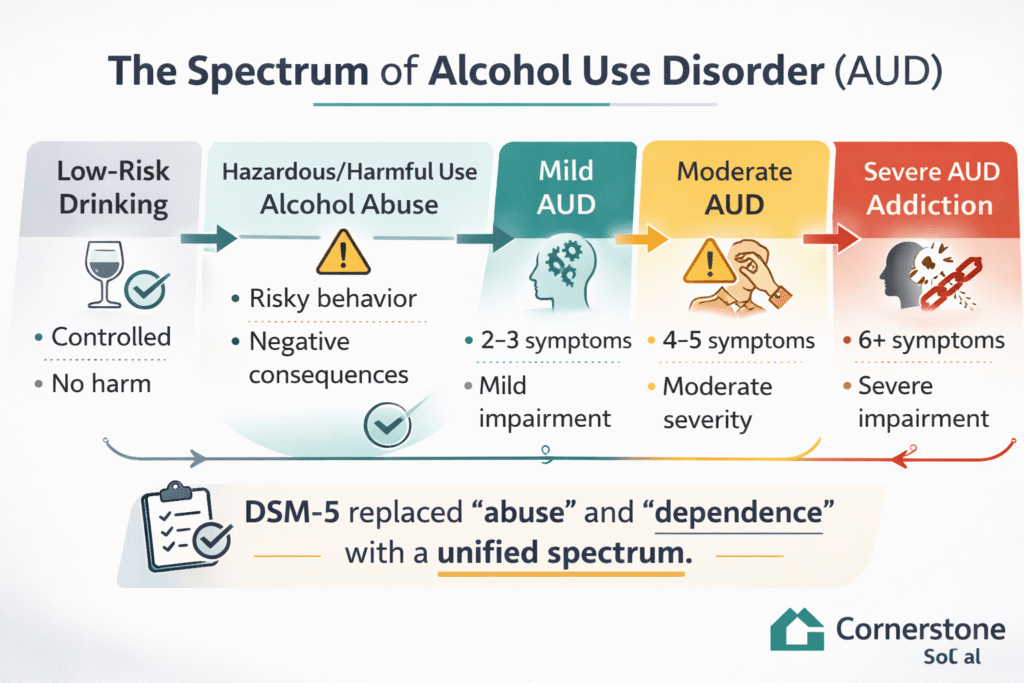
In 2013, the DSM-5 replaced both "alcohol abuse" and "alcohol dependence" with a single unified diagnosis: Alcohol Use Disorder (AUD). This change reflects the current clinical consensus that alcohol problems exist on a spectrum of severity rather than as two discrete categories. AUD is now diagnosed when a person meets at least two of eleven specified criteria within a twelve-month period, and severity is classified as:
- Mild AUD: 2–3 criteria met
- Moderate AUD: 4–5 criteria met
- Severe AUD: 6 or more criteria met
What was previously called "alcohol abuse" maps broadly onto mild-to-moderate AUD in the DSM-5 framework. What was previously called "alcohol dependence" maps broadly onto moderate-to-severe AUD. The core insight is that these are points on a continuum, not categorically different conditions.
What Does "Alcohol Abuse" Mean in Practice?
While the term "alcohol abuse" is no longer a formal DSM diagnosis, it remains widely used in everyday clinical conversation, public health contexts, and among patients and families. In practical terms, it typically describes a pattern of drinking that is causing recognisable harm - to health, relationships, work, finances, or safety - without necessarily involving the full hallmarks of established dependence such as significant tolerance, withdrawal symptoms, or a complete inability to control intake.
A person who regularly drinks to the point of intoxication, who has had alcohol-related accidents or conflicts, who drinks in situations where it is risky (before driving, at work), but who can still choose not to drink on some occasions and does not experience withdrawal symptoms, would typically be described as engaging in alcohol abuse rather than addiction in the traditional framework. Their use is causing harm, but the compulsive, biologically-driven loss of control that characterises addiction has not yet fully developed.
What Does "Alcohol Addiction" Mean Clinically?
Alcohol addiction - or severe alcohol use disorder in DSM-5 terminology - is characterised by several features that go beyond the harm caused by problematic drinking:
- Physical dependence: The brain and body have adapted to the presence of alcohol, requiring it to function normally and producing withdrawal symptoms when it is removed. This is a neurobiological state, not simply a strong habit.
- Compulsion and loss of control: The person experiences powerful, persistent urges to drink that are difficult to resist, and is unable to reliably control the amount consumed once drinking begins - even when they genuinely intend to.
- Continued use despite serious harm: Drinking persists despite clear, serious consequences - health problems, relationship destruction, professional collapse - because the neurobiological drive to drink has become stronger than the cognitive capacity to choose otherwise.
- Reorganisation of life around alcohol: The full scope of a person's time, energy, and priorities has shifted toward obtaining, consuming, and recovering from alcohol.
Why Does the Distinction Matter for Treatment?
The distinction between alcohol abuse (or mild-to-moderate AUD) and addiction (severe AUD) matters because it informs the level and type of treatment most appropriate. A person with mild AUD causing harm through risky drinking may benefit from brief intervention, motivational counselling, and outpatient support - without necessarily requiring the intensity of residential treatment or medically supervised detoxification. A person with severe AUD and physical dependence typically requires a higher level of care: medically supervised detox to manage withdrawal safely, followed by comprehensive inpatient or intensive outpatient treatment that addresses the neurobiological, psychological, and social dimensions of established addiction.
Crucially, both ends of the spectrum deserve clinical attention. Waiting for alcohol abuse to progress to full addiction before seeking help means allowing harm to accumulate and the condition to become harder to treat. Mild and moderate AUD are real clinical conditions with real consequences - and treatment at this stage is typically more straightforward, faster, and associated with better outcomes than treatment delayed until the condition is severe. At Cornerstone SoCal, we provide comprehensive assessment that identifies where on the spectrum a person is, and develops a treatment plan proportional to their actual clinical needs - not a one-size-fits-all approach.
In Network With


















What Clients Say About Cornerstone

We are here for you

Danielle Graniello is a healthcare professional from Orange County, California, with more than 14 years of experience supporting patients and families across medical, treatment, and mental health settings. She spent nine years working with individuals affected by traumatic brain injuries and spinal cord injuries, developing a strong foundation in compassionate care, patient support, and complex healthcare needs.