Is evidence-based treatment more effective for alcohol addiction?
Yes - evidence-based treatment consistently produces better outcomes for alcohol addiction than non-evidence-based approaches. This is not a nuanced or contested point in addiction medicine; it is one of the most well-established findings in the research literature. Understanding what makes a treatment "evidence-based," which specific approaches have the strongest support, and why the evidence base matters for choosing treatment helps individuals and families make more informed decisions about care.
What Does "Evidence-Based" Mean in Alcohol Addiction Treatment?
An evidence-based treatment is one that has been subjected to rigorous scientific evaluation - typically through randomised controlled trials (RCTs), the gold standard of clinical research - and shown to produce significantly better outcomes than a control condition (no treatment, placebo, or treatment-as-usual). To be considered evidence-based in the strong sense, a treatment needs to have been replicated across multiple independent studies, in different populations and settings, with consistent results.
The distinction matters because the addiction treatment field has historically included many approaches that persist based on tradition, intuition, or ideology rather than clinical evidence - some of which are harmless but ineffective, and some of which are actively counterproductive. Choosing a treatment provider or programme that uses evidence-based approaches meaningfully increases the probability of a positive outcome.
Which Treatments Have the Strongest Evidence for Alcohol Addiction?
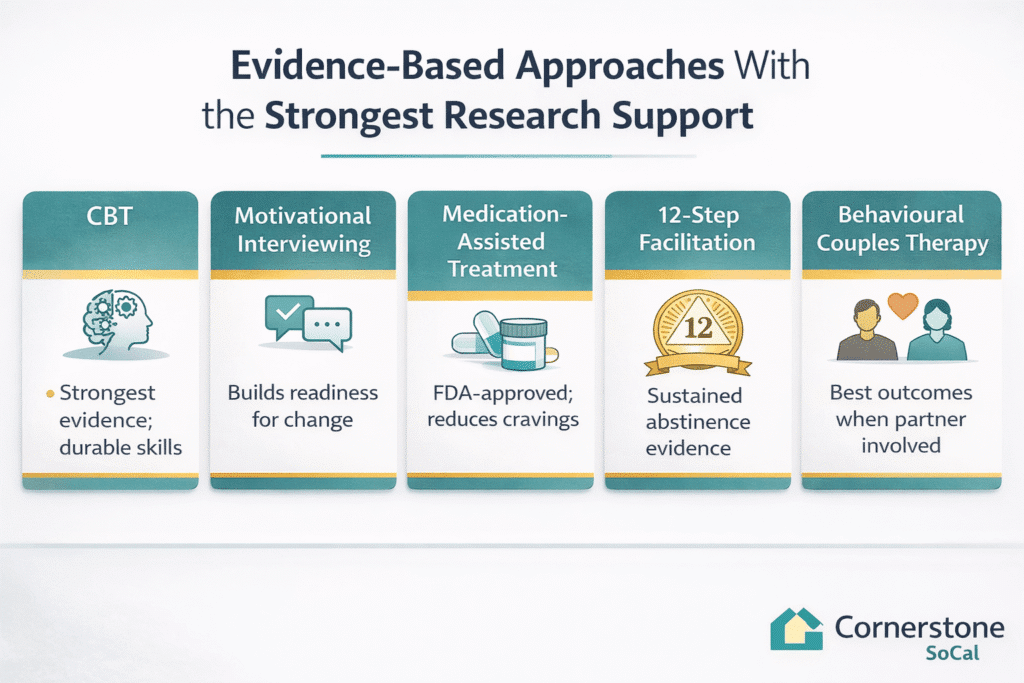
Several treatments have accumulated strong, replicated evidence bases specifically for alcohol use disorder:
- Cognitive Behavioural Therapy (CBT): Among the most extensively validated psychological treatments for AUD, with strong evidence across individual and group formats, in-person and online delivery. CBT produces durable improvements in drinking outcomes and relapse prevention skills, and its effects are maintained well beyond the active treatment period.
- Motivational Interviewing (MI): A person-centred approach with strong evidence for increasing treatment engagement, reducing resistance, and improving drinking outcomes. MI is particularly effective as an entry point to treatment and in combination with other approaches. A large meta-analysis found that MI produced significant improvements in drinking outcomes across more than 100 studies.
- Medication-Assisted Treatment (MAT): Naltrexone (oral and injectable), acamprosate, and disulfiram are all FDA-approved medications with evidence bases supporting their use in reducing craving, preventing relapse, and improving abstinence rates. The combination of naltrexone and CBT has produced particularly strong results in major clinical trials including the COMBINE study.
- 12-Step Facilitation (TSF): Structured facilitation of engagement with AA and 12-step principles has a solid evidence base when delivered as a clinical intervention. A landmark Cochrane review found AA/TSF more effective than other interventions for achieving continuous abstinence. TSF works best in combination with other evidence-based treatments.
- Behavioural Couples Therapy (BCT): For people in committed relationships, BCT - which involves the partner in the treatment process - produces consistently better outcomes than individual treatment alone, including higher abstinence rates, fewer relapses, and improved relationship quality.
- Contingency Management (CM): Uses structured positive reinforcement to support abstinence and treatment engagement. Strong evidence in addiction treatment broadly, with growing evidence specific to AUD.
What Approaches Lack Strong Evidence - or Are Counterproductive?
While the addiction treatment field has improved significantly in adopting evidence-based practices, some widely used approaches have weak or inconsistent evidence, and a few have evidence suggesting potential harm:
- Confrontational approaches: Highly confrontational or coercive interventions - particularly those based on the idea that people must be "broken down" before they can accept help - have consistently weak or negative evidence and are associated with higher dropout rates. Motivational, collaborative approaches consistently outperform confrontational ones.
- Unevaluated "holistic" or experiential programmes: Many residential programmes include activities (equine therapy, adventure therapy, art therapy, etc.) that may have value as supportive components but have limited rigorous evidence as primary treatment modalities for AUD specifically. Their value should be considered supplementary to, not replacements for, validated core treatments.
- Punishment and shame-based approaches: Any treatment philosophy that uses shame, punishment, or humiliation as therapeutic tools has no evidence base and runs counter to the well-established finding that shame increases relapse risk and treatment avoidance.
What Does NIDA Say About Effective Addiction Treatment?
The National Institute on Drug Abuse (NIDA) has published a set of evidence-based Principles of Drug Addiction Treatment that provide a helpful framework for evaluating any programme. Key principles include: addiction is a complex brain disorder requiring comprehensive treatment; no single treatment works for everyone; treatment needs to address all of the person's needs, not just drug use; remaining in treatment for an adequate period of time is critical; and medications are an important element of treatment when available. These principles are directly applicable to alcohol addiction treatment and reflect the best available evidence on what produces lasting outcomes.
How Should You Evaluate a Treatment Programme's Evidence Base?
When assessing any alcohol addiction treatment programme, some direct questions are worth asking:
- What specific therapeutic modalities do you use, and what is the evidence base for each?
- Are your therapists trained and credentialed in evidence-based approaches like CBT, MI, or DBT?
- Do you offer medication-assisted treatment, and do you work with a prescriber experienced in AUD?
- How do you measure treatment outcomes, and can you share data on your programme's results?
- Is your treatment individually tailored, or does everyone follow the same programme regardless of their specific needs?
At Cornerstone SoCal, evidence-based treatment is not a marketing phrase - it is the foundation of every clinical decision we make. We use validated therapeutic approaches, clinician credentialing in evidence-based modalities, and outcomes monitoring to ensure that our care reflects the best available evidence. When you choose us, you are choosing a programme built on what actually works.
In Network With


















What Clients Say About Cornerstone

We are here for you

Danielle Graniello is a healthcare professional from Orange County, California, with more than 14 years of experience supporting patients and families across medical, treatment, and mental health settings. She spent nine years working with individuals affected by traumatic brain injuries and spinal cord injuries, developing a strong foundation in compassionate care, patient support, and complex healthcare needs.