
Can I self-diagnose alcohol addiction with a quiz?
Validated self-assessment tools - often called alcohol screening questionnaires or quizzes - can be a valuable first step in understanding your relationship with alcohol. They can help identify patterns that may indicate harmful drinking or alcohol use disorder, and they can provide a structured way to reflect honestly on drinking behaviour. However, a self-administered quiz cannot provide a formal clinical diagnosis, and it is important to understand both what these tools can tell you and where their limitations lie.
What Are the Most Widely Used Alcohol Self-Assessment Tools?
Several validated screening instruments are widely used by healthcare professionals and available to individuals for self-administration:
- AUDIT (Alcohol Use Disorders Identification Test): Developed by the World Health Organization, the AUDIT is the most widely validated alcohol screening tool in clinical use worldwide. It consists of ten questions covering alcohol consumption levels, drinking behaviour, and alcohol-related consequences or dependence symptoms. Scores range from 0 to 40; a score of 8 or higher typically indicates hazardous or harmful alcohol use, while higher scores suggest the likelihood of alcohol dependence. The AUDIT-C is a brief three-question version often used in primary care settings.
- CAGE Questionnaire: A four-item tool that asks about attempts to Cut down drinking, Annoyance at criticism about drinking, Guilt about drinking, and using alcohol as an Eye-opener in the morning. Two or more positive responses are considered a positive screen for alcohol use disorder. The CAGE is quick and easy to administer but less sensitive to hazardous drinking in the absence of obvious dependence symptoms.
- MAST (Michigan Alcoholism Screening Test): A 25-item questionnaire covering the consequences and patterns of alcohol use, with a scoring threshold that indicates the likely presence of alcohol use disorder. A shorter version (SMAST) contains 13 items.
- SASQ (Single Alcohol Screening Question): Simply asking ""How many times in the past year have you had five or more drinks in a day (for men) / four or more (for women)?"" A positive response has reasonable sensitivity for identifying unhealthy alcohol use in primary care settings.
What Can a Self-Assessment Quiz Tell You?
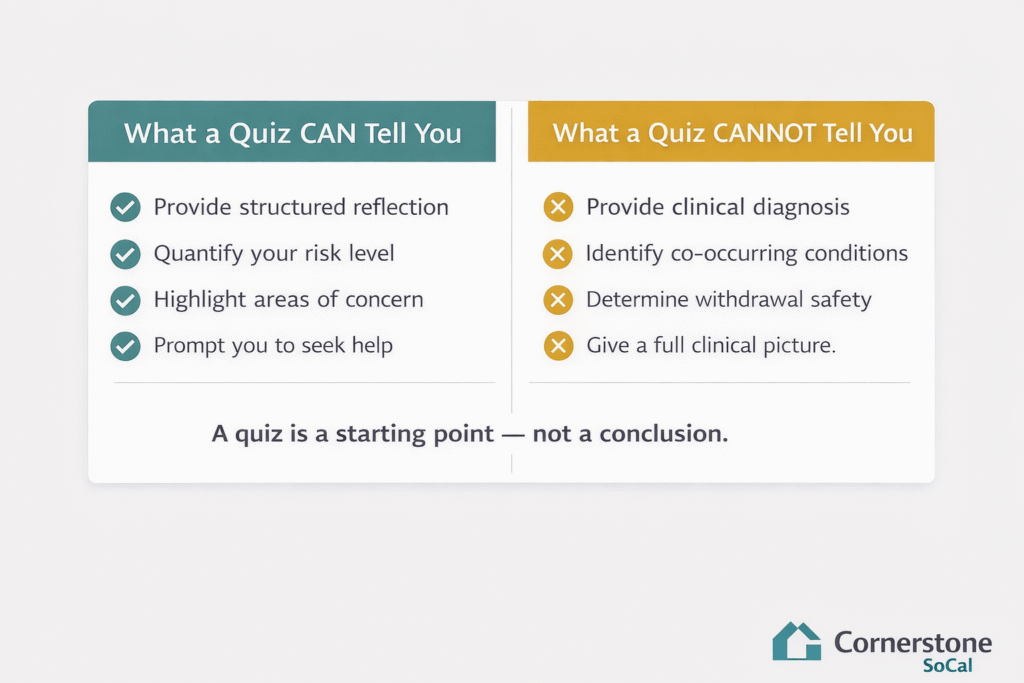
A well-validated screening tool can provide several genuinely useful things. It can give you structured, objective language for patterns you may have noticed but struggled to articulate. It can quantify where your drinking falls relative to clinical thresholds - helping to contextualise whether your level of drinking is in a range that carries health and addiction risk. It can identify specific areas of concern: whether the issue is primarily the amount you drink, the consequences it produces, the sense of compulsion or loss of control, or the presence of physical dependence symptoms. And it can serve as a meaningful prompt to seek professional evaluation - a kind of mirror that makes it harder to dismiss a concern you have been carrying privately.
What Can a Quiz NOT Tell You?
A self-administered quiz cannot provide a clinical diagnosis of alcohol use disorder. Diagnosis requires a structured clinical interview conducted by a qualified clinician - a process that involves far more than summing a score on a questionnaire. A thorough clinical assessment considers the full context of a person's drinking history, the timeline and interaction of symptoms, the presence of co-occurring mental health conditions, medical history and current physical health, social and environmental factors, and safety considerations around withdrawal risk. None of this can be captured by a questionnaire alone.
Self-assessment tools also have inherent limitations around honest self-reporting. People who are ambivalent about their drinking, or who are experiencing denial, may answer questions in ways that minimise their actual situation - producing a score that underestimates the severity of the problem. Conversely, some people with acute distress about their drinking may overreport in a way that doesn't accurately reflect the clinical picture. A clinician can probe and contextualise in ways a questionnaire cannot.
How Should You Use a Self-Assessment?
The most constructive way to use an alcohol self-assessment is as a starting point for honest reflection - not as a final verdict. If your results suggest a level of drinking that falls in the hazardous or harmful range, this is a meaningful signal worth taking seriously and discussing with a healthcare provider. If the results feel surprising - if you scored lower than expected but recognise some of the patterns described in the questions - that, too, is worth sitting with honestly.
A self-assessment is not a reason to conclude definitively that you do or do not have a problem. It is an invitation to look more honestly at your relationship with alcohol, and if the picture is concerning - in any way - to take the next step toward a professional conversation.
What Should You Do After Taking a Self-Assessment?
If a self-assessment raises concerns - whether the score is in the clearly problematic range or simply touches on patterns you recognise and have been worried about - the appropriate next step is a conversation with a qualified clinician. Your primary care doctor is a good starting point; they can conduct a more detailed assessment, discuss the results in the context of your overall health, and make referrals to appropriate specialist services if warranted. Alternatively, an addiction specialist or a treatment centre like Cornerstone SoCal can provide a comprehensive dual diagnosis assessment that evaluates both your alcohol use and any co-occurring mental health conditions that may be driving or worsening it. A self-assessment raises questions. A clinical evaluation answers them.
In Network With
















What Clients Say About Cornerstone

We are here for you

Danielle Graniello is a healthcare professional from Orange County, California, with more than 14 years of experience supporting patients and families across medical, treatment, and mental health settings. She spent nine years working with individuals affected by traumatic brain injuries and spinal cord injuries, developing a strong foundation in compassionate care, patient support, and complex healthcare needs.