
Are medications for alcohol addiction safe long-term?
Concerns about the safety of medications for alcohol addiction - particularly about whether they are themselves addictive, or whether long-term use poses health risks - are among the most common reasons people hesitate to consider pharmacological support for their recovery. These concerns are understandable, but in most cases they reflect misconceptions that are worth addressing directly with accurate clinical information. The short answer is that the two most widely used medications, naltrexone and acamprosate, have well-established safety profiles and are not addictive - making them appropriate for long-term use in the context of ongoing clinical monitoring.
Is Naltrexone Safe for Long-Term Use?
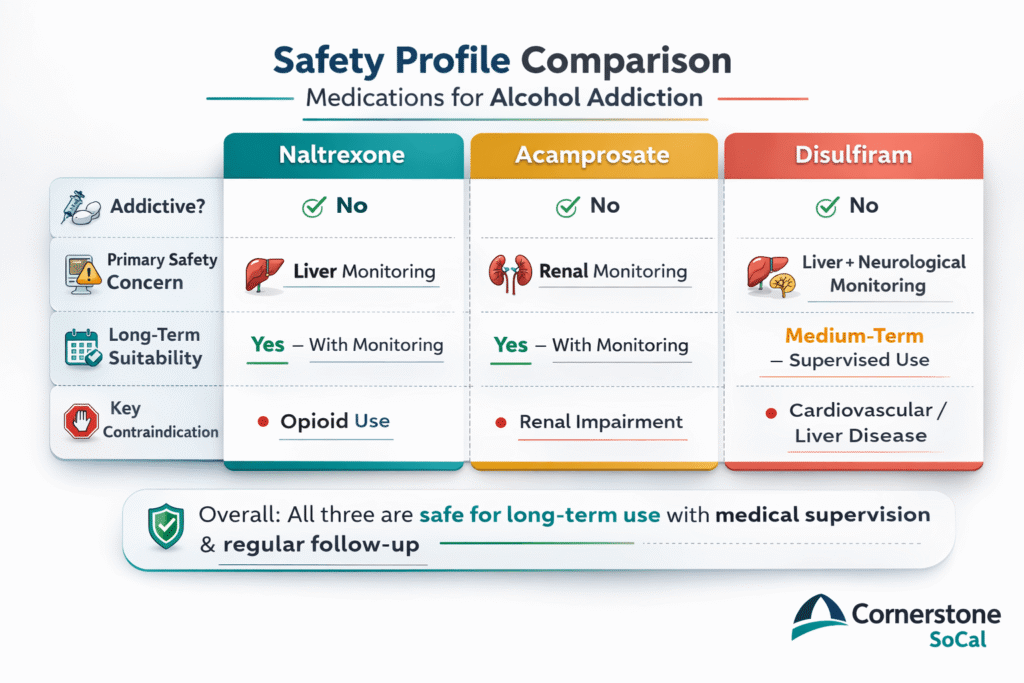
Naltrexone has been in clinical use for alcohol use disorder since FDA approval in 1994, and its long-term safety profile is well-established through decades of post-marketing surveillance and multiple long-duration clinical studies. Key safety considerations include:
- Non-addictive: Naltrexone does not produce euphoria, sedation, or any pleasurable effect. It does not create physical dependence or withdrawal symptoms when stopped. There is no evidence of abuse or misuse potential, and it can be discontinued without a tapering protocol.
- Hepatotoxicity risk: At very high doses - substantially above the therapeutic doses used for AUD (50mg oral or 380mg injectable monthly) - naltrexone can cause liver toxicity. At therapeutic doses, the risk of clinically significant liver injury is low, though baseline liver function tests and periodic monitoring are recommended, particularly in people with pre-existing liver disease. In people with severe hepatic impairment (decompensated cirrhosis), naltrexone is contraindicated.
- No tolerance development: Naltrexone does not become less effective with prolonged use - there is no evidence of tolerance to its anti-craving or anti-relapse effects over time.
- Opioid interactions: The most significant ongoing consideration with long-term naltrexone use is that it blocks opioid receptors - meaning that opioid pain medications will be ineffective at normal doses while naltrexone is active. This is clinically manageable but requires clear communication with all treating physicians, particularly in the context of surgical or emergency care.
Is Acamprosate Safe for Long-Term Use?
Acamprosate has an excellent long-term safety profile and is among the best-tolerated medications used in addiction treatment. Its key safety characteristics include:
- Non-addictive: Like naltrexone, acamprosate has no abuse potential, produces no euphoria or dependence, and can be discontinued without tapering.
- Renal clearance: Acamprosate is cleared by the kidneys rather than the liver - making it safe to use in people with liver disease who cannot take naltrexone. However, it is contraindicated or requires dose adjustment in people with significant renal impairment, and renal function should be monitored during long-term use.
- Minimal drug interactions: Acamprosate has very few significant drug interactions, contributing to its good safety profile even in people taking multiple medications for co-occurring conditions.
- Common side effects: The most frequently reported side effects are gastrointestinal - diarrhoea, nausea, and flatulence - which are typically mild and often diminish with continued use. Acamprosate has not been associated with serious adverse effects at therapeutic doses in long-term studies.
Is Disulfiram Safe for Long-Term Use?
Disulfiram requires more careful monitoring with long-term use than naltrexone or acamprosate, due to several important considerations:
- Hepatotoxicity: Disulfiram can cause liver inflammation and damage (hepatotoxicity) independent of the disulfiram-alcohol reaction - a risk that requires baseline liver function testing before initiation and periodic monitoring throughout treatment. People with significant liver disease should generally not take disulfiram.
- Neurological effects: Long-term disulfiram use has been associated with peripheral neuropathy and, in rare cases, optic neuritis. These effects are uncommon but require clinical monitoring.
- Psychiatric effects: Disulfiram can exacerbate depressive symptoms and psychotic episodes in vulnerable individuals, requiring psychiatric monitoring during long-term use.
- Duration of use: Most clinical guidelines recommend disulfiram as a medium-term intervention - typically six months to one year - rather than indefinitely, reflecting both the monitoring burden and the evidence that it is most useful as a time-limited deterrent during the early phase of recovery rather than as a lifelong treatment.
How Long Should Medications Be Continued?
There is no universal answer to the optimal duration of medication treatment for alcohol use disorder - it depends on the individual's clinical trajectory, their relapse risk, their response to the medication, and their recovery progress. What the research does clearly suggest is that premature discontinuation - stopping medication before stable recovery has been established - substantially increases relapse risk. Many clinical guidelines suggest a minimum of six to twelve months of pharmacotherapy for AUD, with consideration of longer-term maintenance for people with severe addiction, multiple prior relapses, or ongoing high relapse risk.
The decision to discontinue medication should always be made collaboratively with a prescriber and coordinated with other components of the treatment plan. Stopping medication should not be the end of support - it should be accompanied by a clear plan for how sobriety will be maintained through therapy, peer support, and other recovery resources.
Are There Any Medications That Should Not Be Used Long-Term?
Benzodiazepines - while essential for the acute management of alcohol withdrawal - are generally not appropriate for long-term use in people with alcohol use disorder due to their significant abuse and dependence potential. The same neurobiological vulnerabilities that make a person susceptible to alcohol addiction also increase the risk of developing benzodiazepine dependence, and cross-dependence between alcohol and benzodiazepines is well-documented. After the acute withdrawal phase, benzodiazepines should be tapered and discontinued, with transition to non-addictive pharmacological support if ongoing medication is indicated.
At Cornerstone SoCal, all medication decisions - including duration, monitoring, and discontinuation planning - are made by experienced addiction medicine clinicians who consider the full clinical picture. Our goal is medication management that is safe, effective, and integrated with the broader treatment plan in service of lasting recovery.
In Network With


















What Clients Say About Cornerstone

We are here for you

Danielle Graniello is a healthcare professional from Orange County, California, with more than 14 years of experience supporting patients and families across medical, treatment, and mental health settings. She spent nine years working with individuals affected by traumatic brain injuries and spinal cord injuries, developing a strong foundation in compassionate care, patient support, and complex healthcare needs.